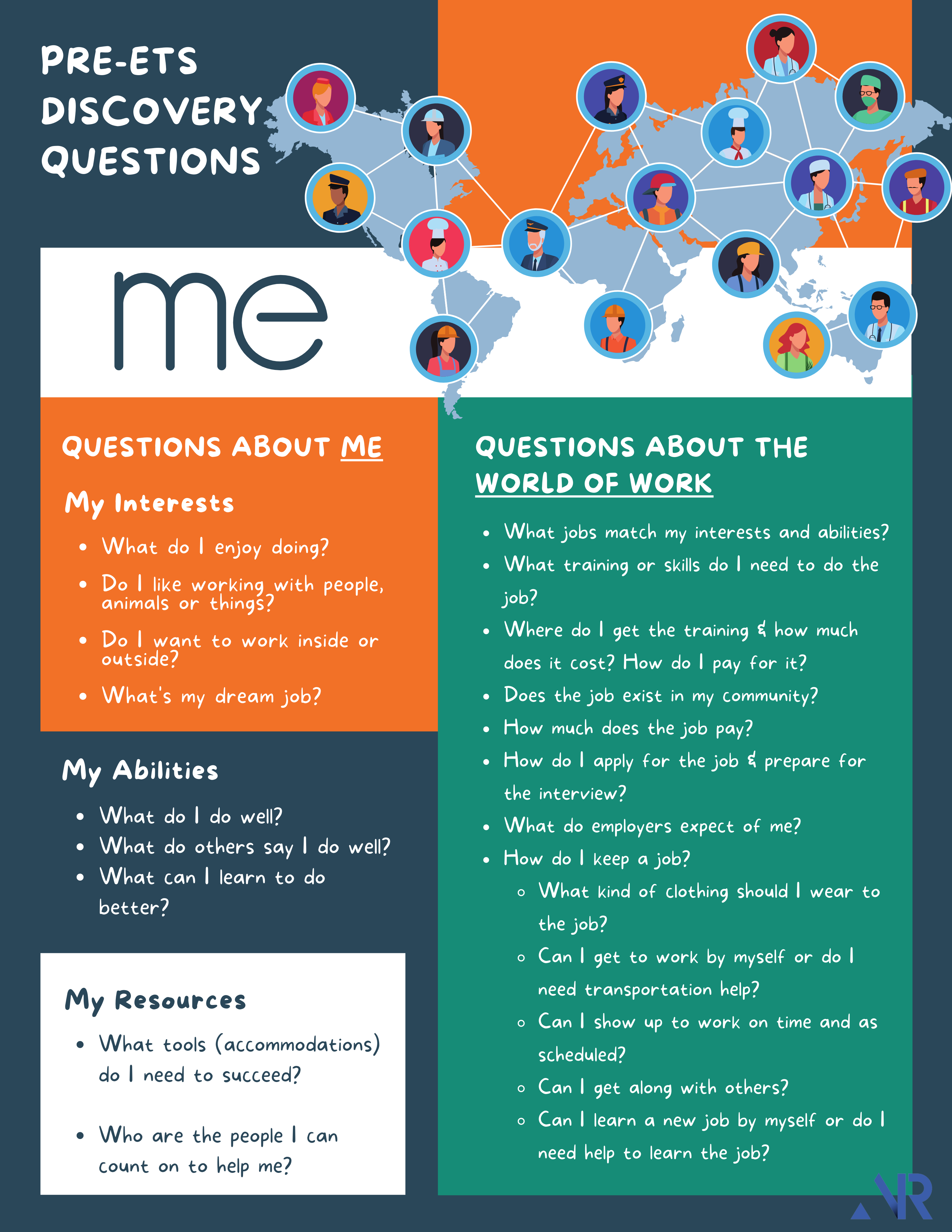
PurposeThese exploratory services, conducted individually or in a group setting, are designed to lead students on a journey of discovery wherein they uncover information in two main domains: 1. Information about themselves 2. Information about the world of work Counselor Role: Gold Miner One of the most rewarding parts of our work is helping youth identify their interests and abilities. Once captured, this information is like vocational currency. It can fulfill both the employee's career aspirations and the employer's business needs. For this writer, it's like mining for gold. Just as a pick is a tool for the gold miner, key questions are the counselor's tools to help youth uncover their unique interests, abilities, and accommodation needs. Once these attributes are known, the counselor can use additional key questions to help the students: 1. discover which jobs best match their interests and abilities and 2. identify the services they need to prepare for, get and keep a job Key questions are illustrated in the following graphic. For an accessible version of the graphic, click this link: Discovery Questions.docx
TOOL: Pre-ETS Discovery Questions Document. Click to Print or Download Supporting Evidence
|