Meet the Crew and the Challenge The students in the virtual simulation lab at UWGLive have become an integral part of our training program. They are featured in the image below. From left to right, they are Savannah, Dev, Nate, Jasmine, and Ethan. Each student lives with a disability commonly encountered in vocational rehabilitation offices. Along with their unique personalities, their disability influences their perceptions and behaviors. Below are brief bios highlighting common behaviors related to each person’s disability. Following the behaviors are ideas—in italics and blue text—on how to tailor your response. 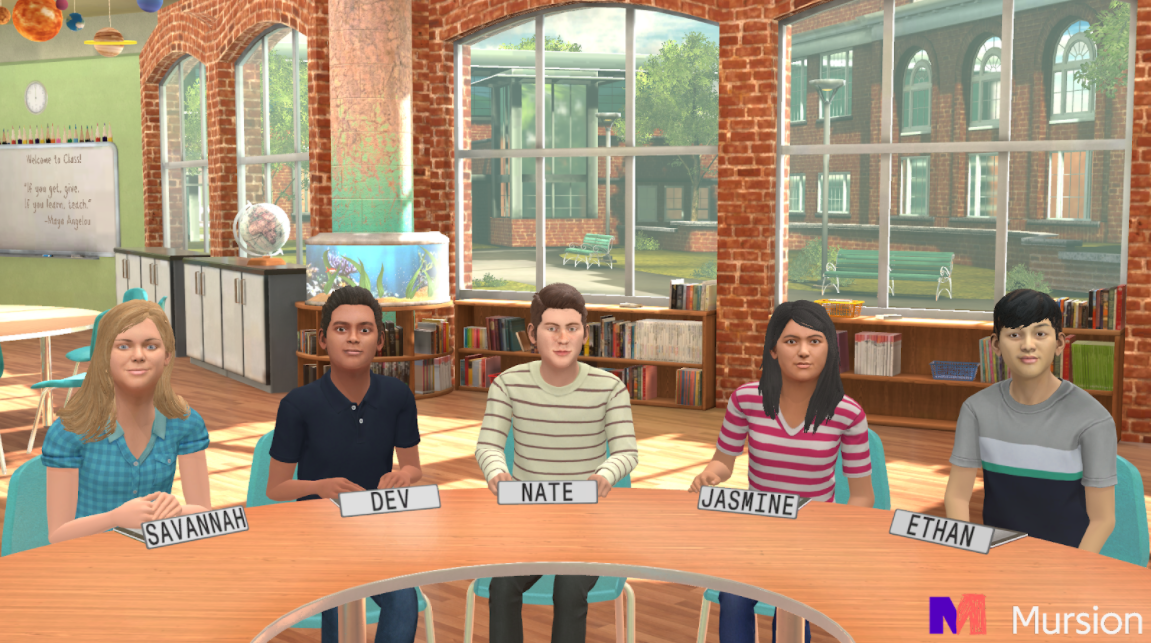
Savannah (Intellectual Disability) Because of her disability, Savannah can become lost or unable to make sense of the conversations that may take place in a group setting with classmates with more advanced intellectual abilities. In a group setting, Savanah may: -
- Tune out (look down or off into space) in conversations that may exceed her ability to understand. She requires prompts to tune back in AND rephrasing to help her understand the topic of conversation, thereby including her.
-
- Go off-topic by interjecting a topic that is not germane to the current conversation. She requires gentle prompts to return to the topic at hand.
-
- Indicate confusion by saying, “I don’t understand.” She requires 1) positive feedback for sharing her confusion and 2) rephrasing to help her understand, including her in the conversation.
Dev (Juvenile Diabetes) Dev hates that his diabetes equipment makes his "invisible" disability visible. He doesn't like talking about it or any subject wherein it might come up. Likewise, In a group setting, Dev may: -
- Withhold comments or defers to classmates. He requires encouragement and light prompts to share with the group.
Nate (Autism Spectrum Disorder, Level 1) As a result of his disability, Nate may miss references or nuances conveyed in group conversations. He also may monopolize the conversation with a topic of his interest and become preoccupied with the schedule. In a group setting, Nate may:
- Speak in a monotone voice or sound robotic. (The facilitator/counselor would not address this in the group. Rather, the counselor may talk with him individually and refer him to a speech and language specialist for work on tone and pitch.)
- Perseverate on topics of interest to him. He requires prompts to return to the topic at hand or to allow others an opportunity to speak.
- Miss social cues, including body language and figures of speech such as sarcasm or idioms—he takes things literally. He may require rephrasing to help him understand the intent of a fellow student’s figure of speech. For example, if somebody in the group said, “Knock it off,” Nate might ask, “Knock what off?” and look around the table for what he was supposed to knock off. A rephrasing could include something like: “I can see why that’s confusing. In this case, ‘knock it off’ means to stop doing something, like ‘stop teasing me.’ Does that make sense?”
-
- Interrupt others if he believes a meeting will exceed the allotted time. He rigidly adheres to schedules and becomes agitated if it appears that the meeting may interfere with his routine. He requires a gentle reminder that the facilitator knows the schedule is important and that s/he is mindful of the time to end the group on time.
Jasmine (Attention-Deficit/Hyperactivity Disorder) Jasmine exhibits behaviors that can be regarded as “annoying,” “scattered,” or “ditzy’ by others. Because she doesn’t read body language well, she doesn’t recognize the cues and, therefore, doesn't adjust her behavior. In a group setting, Jasmine may:
- Speak too fast, making it difficult to understand her. She requires a gentle prompt that helps her slow down. For example, “Whoa, we really want to understand what you’re saying, so it would help to slow down a bit. Okay?”
- Interrupt others; is not good at reciprocal information; talks over the top of others and doesn’t listen; others must repeat themselves; requires a reminder prompt for everybody to take turns speaking. For example, “I can tell you’re excited, Jasmine, but it’s hard to hear everybody talking at once. Let’s let (insert student name) finish, and then you can speak. Okay?”
- Speak too loudly and doesn’t modulate her voice according to setting or situation. She requires gentle prompts to help her modulate her volume, such as “Jasmine, I love your enthusiasm, but we have to lower our voices so that we don’t unintentionally disrupt the class next door.”
-
- Say inappropriate things that violate social norms. She may divulge information that is too personal or inadvertently insult somebody with an observation regarded a too personal. She may require a gentle prompt such as, “Thanks for sharing that, Jasmine. Why don’t you and I discuss that after group, okay?”
Ethan (Dyslexia, an auditory processing disorder, and anxiety) Because of his auditory processing deficit, Ethan may not trust that he correctly understood what the group facilitator was asking. Because he doesn’t yet understand his disability nor has coping strategies for it, Ethan may:
-
- Dodge the question saying, “I’m not sure.” -or- “I need some time to think about that.” A prompt may include: “Okay, we’ll come back to you.”
-
- Defer to another student to answer. For example, he may point to a fellow student and say in a good-natured demeanor something like, “Why don’t you ask her? She loves answering questions.” A prompt may include: “Well, she’ll have her turn. Now, it’s your turn. We really want to hear what you have to share.”
-
- Use distraction to deflect. He may say something completely off-topic, like, “I like your kicks, Dr. Olivia. They are rad!” A prompt may include: “Gee, thanks, Ethan. Now, let’s return to the topic..(here, the counselor repeats the topic/question)”
-
- Use humor to deflect if he makes a mistake. For example, if he offers a response but gets the impression that his response is off, he may say something like “I meant to say that!" or “For my next trick!” An encouragement may include: “No worries, we all do that from time to time, right guys?”
|