| After uncovering and verifying the clients' contributions, the VRC meets with the employer to begin the discovery process on that end via the steps listed below. Conduct Informational Interview The VR professional conducts informational interviews with employers to build rapport, introduce business services, build disability understanding, and uncover unmet business needs. During the interviews, the VRC: Forestall common employer objections by raising and responding to them before the employer does. Bill Santos, a job development expert with EMP Oakville, says that "the vast majority of objections are false assumptions." He adds that the easiest way to counter objections is to "forestall the objection" Doing so will positively influence the employers' perceptions and eliminate barriers. For example, after introducing yourself and your services, you may raise and respond to common objections illustrated in the examples below:
Asks strategic questions to identify necessary work tasks, not behaviors. Many employment specialists may lead with these questions:
In response, employers will likely provide a list of desirable behaviors (e.g., always on time, friendly, go-getter) and undesirable behaviors (e.g., always late, called in sick, didn't get along with others). While work behaviors are essential, we need a list of job tasks to make a good match. Toward that end, consider the following questions:
Uses OARS! That is, after asking the open-ended questions noted above, don't forget to follow up with:
Personalize the Message The VR professional can encourage better understanding and cooperation by inquiring if the employer has any family or friends who live with disabilities. This question asks them to recall how opportunities have or have not been afforded to the people they know and love who live with disabilities. For any of us, this question encourages consideration: "How would I want my family or friends with disabilities to be treated in this situation?" Arrange Work Experience The VR professional arranges a work experience to clarify/verify the worker's job interests and abilities by observing the job seeker doing the job and identifying support needs. Negotiate Customized Job Description The VR professional negotiates a customized job description specifying the unmet or newly identified tasks. Your response to the employer's list of needs could sound like this: "So, if I could find an individual who could (list tasks), would you consider a hire?" If the employer remains hesitant, you could remind him/her of the free services including:
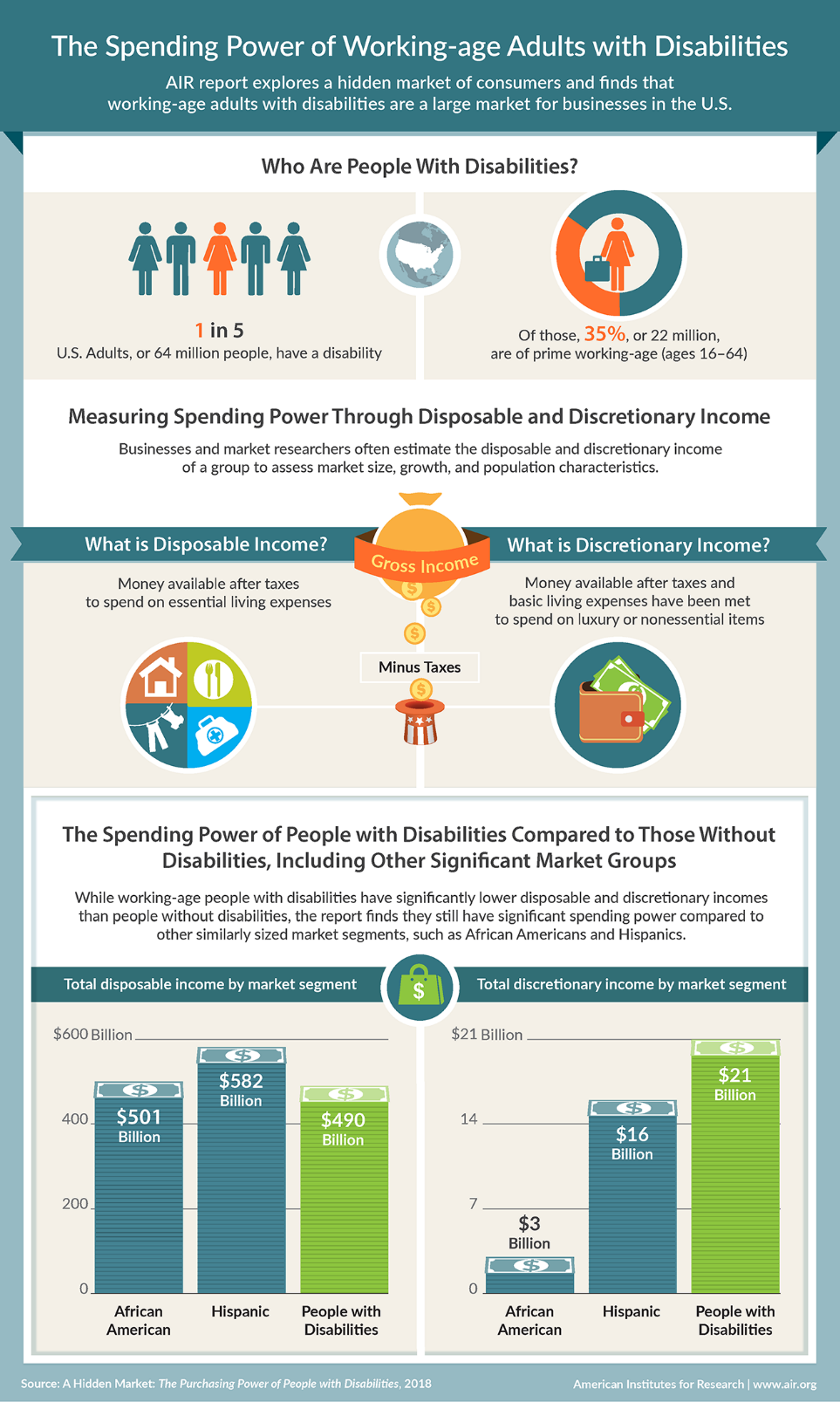
Close the Pitch The VR professional closes the pitch by educating the employers about the social and financial benefits of hiring people with disabilities. People with disabilities represent the world's largest minority. They are more inclined to support businesses that reflect the interests and needs of all customers, including those with disabilities. Moreover, people with disabilties have significant purchasing power. In their report, A Hidden Market: The Purchasing Power of Working-Age Adults with Disabilities, the authors (Yin, Shaewitz, Overton Smith, 2018) shared their key findings:
See the graphic below. For an accessible version of the graphic, click this link. |