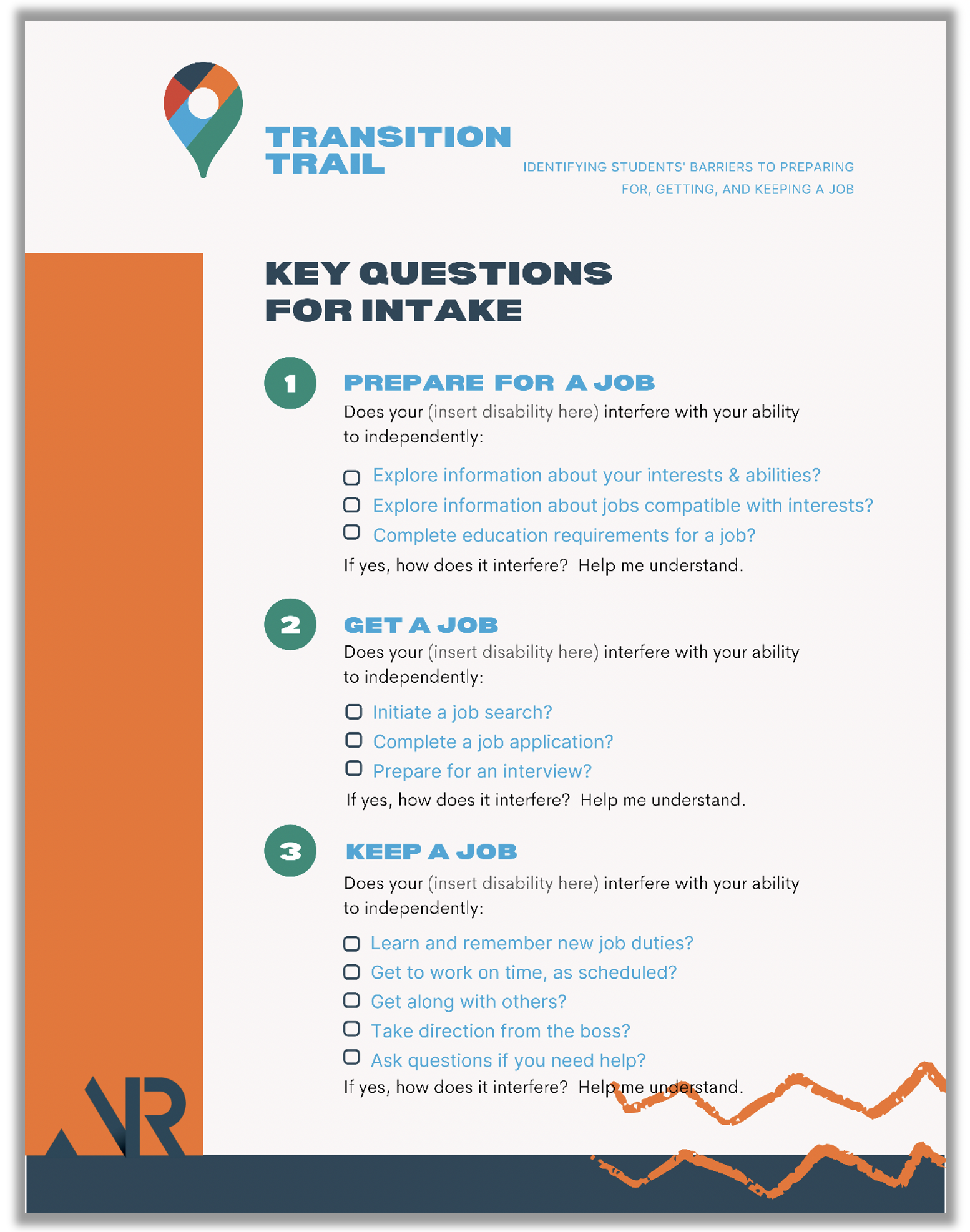
| As we have learned, it's essential to understand how a person's disability interferes with academic or work success. One way we get that information is from medical or psychological documentation. Another way is to ask the students. After all, who knows better than the students themselves? The counselor in our case study gathered information from Ethan to complete the report we just read. What kind of questions do we ask? Where do we begin? The good news is that we already have a framework to guide us. We know the questions will fall under one or more familiar categories: Prepare for a Job, Get a Job, and Keep a Job. Consider the following tip sheet to give you an idea of where to start and what questions to ask. Remember: if you're working with students with intellectual disabilities, you may have to simplify your wording or paraphrase to ensure the information can be understood. It's always a good idea to check in with clients to ensure they understand what you're asking. You can ask something like, "Does that make sense?" or "Do you have any questions about what I just shared?"
TOOL!To download this tool, click this link: Key Questions for Intake. For an accessible Word document, click this link: Key Questions for Intake.docx 360-Degree Video: Intake MeetingThe following video is a brief excerpt from a mock intake meeting. In it, the actors portray Ethan, his mom, and the VR counselor. In the first scene, we see the counselor making some common mistakes. Can you spot them? In the second scene, the counselor uses a key question framework to explore Ethan's interests and identify his disability-related barriers to employment. Notice how she begins with his interests first. To watch the video, containing both auditory description and captions, click on the following link: Click the following link for an accessible transcript of this video. Client Intake Meeting 360.stamped_doc (1).doc While the above video doesn't show the entire meeting, we know from the initial contact report that the VR counselor used the above framework and her understanding of learning disabilities to shape her questions. That is, she asked questions to identify how Ethan's disability interfered with his ability to prepare for, get, or keep a job. For example, she began by asking Ethan how his disability affects him in school. These questions would fall under the Prepare for a Job category. It's important to note that she did not ask the verbatim questions from the tip sheet. Instead, she considered each question'sintent, modified her language to make sense for the student, and then recorded the gist of the exchange in her report. For example, her question about education requirements might have sounded something like: "Ethan, how does your learning disability affect you with reading and writing school assignments? Please help me understand." Then, she quoted Ethan's own words to illustrate his impediments. So, let's look back at that section of the Intake Interview. The italicized text represents the counselor's internal thought process. Reported Disability and Impediment to Employment
After taking the application and obtaining a signed release, the counselor sent for the learning evaluation report. The evaluation report is summarized next. |